The stage play 'Commission Continua', which critiques South Africa's extensive documentation requirements, debuted a few years ago. The production explores the societal impact of bureaucratic processes within the country, offering a critical lens on the nation's approach to addressing complex issues. Tony Bonani Miyambo and Phala Ookeditse Phala co-directed the play, which examines themes related to documentation and its role in South African society, delving into the efficacy and consequences of this reliance on official records.
Thematic Critique of Commissions
The play 'Commission Continua' critiques South Africa's perceived 'obsession with paper trailing its injustices, but without much consequence or change.' This central theme explores the nation's reliance on official documentation and inquiries as a response to societal problems, suggesting a disconnect between the careful process of record-keeping and the achievement of tangible outcomes. The production suggests that while extensive records are generated, tangible resolutions often remain elusive, leading to a cycle where problems are identified but not fully overcome.
South Africa has generated 'mountains of reports' from numerous investigative commissions over the years, according to the play's perspective. These commissions are often established to examine significant issues and past injustices, resulting in extensive documentation and findings that detail various societal challenges and historical events. However, 'Commission Continua' questions the ultimate impact of these reports on fostering meaningful change within the country, pondering whether the sheer volume of documentation truly translates into substantive progress or accountability. The play notes a recurring pattern where societal issues are extensively documented, yet their underlying causes and effects persist.
The establishment and operation of these commissions have incurred substantial financial costs, representing a significant allocation of public funds. These investigative bodies have cost 'billions of Rands', reflecting a considerable public investment in their work and administrative processes. The play's critique extends to whether this considerable expenditure has translated into proportionate improvements or accountability, given the continued presence of systemic issues. It raises questions about the return on investment in terms of actual societal transformation versus the financial outlay on documentation and inquiry. The narrative implies that while resources are poured into these processes, the fundamental problems they aim to address often remain unresolved, leading to a "crisis that refuses resolution."
Artistic Execution and Performance
The play is currently running at the Baxter Theatre until June 13, offering audiences a limited engagement to experience its critique of South African bureaucracy and the broader societal implications of its documentation practices. Tony Bonani Miyambo, who not only co-directed the production but also stars in the play, leads the narrative through its examination of documentation, bringing a nuanced performance to the central themes. The performance integrates a range of specific commissions into its storyline, vividly illustrating the breadth of issues that have undergone official inquiry. These include the commissions investigating mineworker killings in Marikana, issues of state capture that have plagued governance, the collapse of a shopping mall, challenges within higher education, and the broader consequences of political assassinations, particularly the underlying consequences of murdering politicians. This full approach shows the widespread nature of these inquiries across various sectors of South African life.
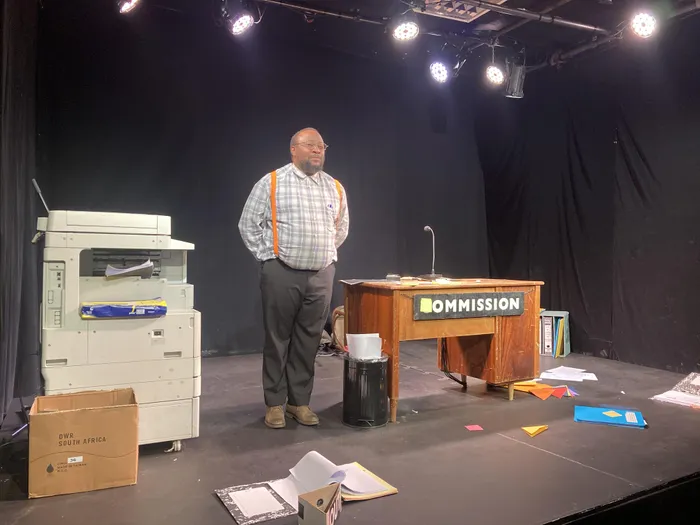
Central to the play's artistic execution is the character portrayed by Bright Maluleke, a "records clerk tasked with copying and archiving the nation’s truth." Maluleke's role shows the theme of widespread documentation, embodying the bureaucratic machinery that meticulously records injustices and societal truths. The character serves as a poignant representation of the individuals caught within and perpetuating the system of endless record-keeping. The production utilizes several on-stage elements to enhance its message and immerse the audience in its thematic concerns. These include a functional photocopy machine, a loop station for sound design, and photo projection to visually represent the archival process and its contents. These tools serve to illustrate the mechanical and repetitive nature of record-keeping that the play critiques, emphasizing the sheer volume and often impersonal nature of the documentation process. Critics have largely responded positively to the production, with the play receiving a ★★★★☆ rating, acknowledging its effective blend of artistic elements and thematic depth in tackling such a critical national issue.
Context and Lasting Questions
Thirty years after the Truth and Reconciliation Commission, the play 'Commission Continua' questions the extent of societal change in South Africa, prompting reflection on the nation's journey since that key moment. The production suggests that despite past efforts to address historical injustices and establish a new path forward, many underlying issues persist, indicating a complex and ongoing struggle for resolution. The play portrays the nation's current situation as a "crisis that refuses resolution," indicating a cycle where problems are identified and documented but not fully overcome, leaving a lingering sense of unaddressed grievances. It also describes South Africa as "so good at archiving its atrocities," noting the extensive documentation of past and present societal failings, from historical injustices to contemporary corruption and violence. This perspective shows a central theme of the play: the apparent gap between careful record-keeping and tangible progress within the country, prompting audiences to consider the true meaning of accountability and change in a society so adept at documenting its own struggles.