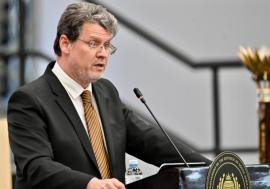
Deputy Minister in The Presidency Kenny Morolong called for the mining sector to serve as a catalyst for South Africa's structural transformation on Thursday, June 4, 2026. Morolong has specifically called for mining to be used as a catalyst for structural transformation across the nation. Speaking in Rustenburg, North West, at the Bojanala District Economic Development Symposium, Morolong stated, "Mining must become the foundation on which we build a diversified and industrialised economy." He urged the district to move beyond merely extracting raw minerals for off-site processing, manufacturing, and export. Morolong challenged the district to look beyond extracting raw minerals and sending them elsewhere for processing, manufacturing, and export. He emphasized that "The world’s most successful resource economies have used mining as a catalyst for manufacturing, engineering services, logistics hubs and research institutions." This strategic shift, he argued, is key for unlocking the full potential of the sector and ensuring broader economic benefits.
Vision for Diversified Economy
Mr. Morolong called for urgent industrialization, deepened localization, and strengthened domestic backward linkages, particularly within the mining value chain. He stressed the importance of expanding opportunities for various economic actors, including small, medium, and micro enterprises (SMMEs), cooperatives, women-owned enterprises, youth-owned enterprises, and black industrialists. He emphasized expanding opportunities for these groups to participate more meaningfully in the economy. Additionally, the Deputy Minister advocated for strengthening municipal capability and improving infrastructure. He also called for strengthening municipal capability and improving infrastructure to ensure economic growth translates into tangible improvements in the lives of ordinary South Africans. He stated this was essential to ensure that economic growth effectively translates into tangible improvements in the lives of ordinary South Africans, addressing historical disparities and promoting inclusive development.
Historical Context of Mining
South Africa's rich mineral endowment has profoundly shaped its economic trajectory. The discovery of diamonds in Kimberley in 1867 transformed South Africa into one of the world’s leading mining economies. This was followed by the discovery of gold on the Witwatersrand in 1886, which further cemented the country's position as a global mining powerhouse. Mining became the foundation upon which railways, ports, financial institutions, manufacturing industries, and modern cities were built. This historical development shows the sector's foundational role in the country's infrastructure and economic architecture. In the Bojanala District, mining remains the dominant economic sector, continuing to drive output, exports, investment, and employment. Its enduring significance in the district notes the continued reliance on this sector for local economic vitality.
Persistent Economic Challenges
The economy that developed under apartheid concentrated ownership, wealth, and productive assets within a minority, largely excluding the majority of South Africans from significant economic participation. The economy that emerged under apartheid concentrated ownership, wealth, and productive assets in the hands of a minority, while excluding the majority of South Africans from meaningful participation in economic activity. Three decades after the end of apartheid, inequality in South Africa remains persistently high. Three decades later, inequality in South Africa remains stubbornly high, posing a significant challenge to national development goals. Despite its resilience, South Africa’s economy continues to experience growth rates that are insufficient to substantially reduce unemployment, poverty, and inequality, according to assessments by the South African Reserve Bank and the International Monetary Fund. These institutions consistently highlight the urgent need for structural reforms to address these deep-seated economic issues. The Deputy Minister's call for the mining sector to drive structural transformation is therefore seen as a critical component of the broader national effort to achieve a more equitable and prosperous society.