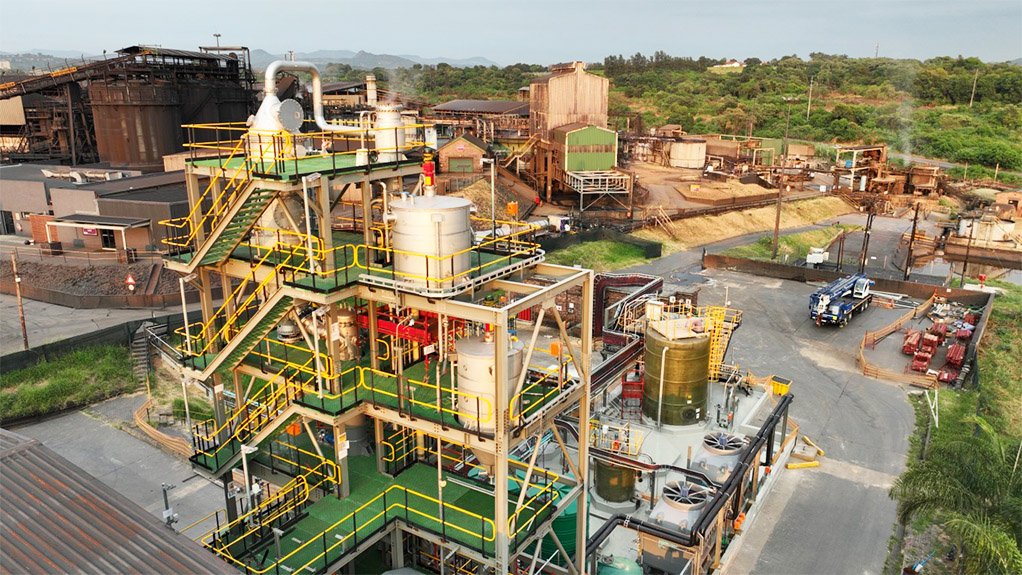
Manganese Metal Company (MMC) has completed the first phase of its battery-grade high-purity manganese sulphate monohydrate (HPMSM) plant, a critical development for the global electric vehicle battery supply chain. The advanced facility is strategically located in Mbombela, Mpumalanga, South Africa, a region known for its rich mineral resources. This initial phase of the facility represents a culmination of years of planning and development, with its project journey having commenced in 2019. The plant now boasts an impressive production capacity of 6,000 tonnes per year (t/y) of HPMSM, a key precursor material for advanced battery chemistries. The HPMSM facility was officially commissioned in 2026, marking a significant and tangible step in South Africa's evolving contribution to the burgeoning battery material supply chain. This achievement positions South Africa as an increasingly important player in providing essential components for the rapidly expanding electric vehicle market worldwide. The production of HPMSM is vital for ensuring a diversified and secure supply of battery materials, reducing reliance on single geographic regions and promoting sustainable sourcing practices.
MMC's Strategic Production Shift and Global Leadership
Manganese Metal Company (MMC) is actively developing a patented ore-to-crystals process, a advanced technological advancement that forms a core component of its broader strategic initiatives. The company holds a unique and significant distinction in the global market: it is the world's only producer of electrolytic manganese metal (EMM) located outside of China. This singular position shows MMC's critical role in ensuring supply diversity for this essential industrial metal. MMC is recognized as the largest global producer of high-purity selenium-free EMM, a specialized form of manganese metal highly sought after for its quality and environmental profile.
In a key strategic move made in 2024, the company decided to pursue a modular ‘metal-to-crystals’ production route for its HPMSM facility. This innovative strategy is designed to leverage MMC's already established EMM production capacity, providing a strong foundation for its new ventures. The approach also capitalizes on the company's existing brownfield infrastructure, allowing for more efficient development and deployment of new production capabilities. Decades of specialized manganese purification expertise within MMC are central to the success of this strategy, ensuring the high quality and purity required for battery-grade materials. The modular ‘metal-to-crystals’ route is specifically intended to reduce capital exposure for the company, making new expansions more financially viable, while simultaneously allowing for a flexible and phased expansion of its operations to meet evolving market demands. This strategic pivot notes MMC's adaptability and foresight in responding to the dynamic requirements of the global battery industry.
Market Context and Future Demand for Manganese
The global market for electric vehicles has experienced exponential growth, directly influencing the demand for essential battery materials. In 2025, combined global sales of battery electric vehicles (BEVs) and plug-in hybrid vehicles (PHEVs) collectively reached more than 21-million units. This substantial and continuously increasing demand in the electric vehicle market underpins the urgent and growing need for high-performance, sustainably sourced battery materials, with manganese playing a key role.
Within the landscape of battery chemistries, lithium iron phosphate (LFP) batteries have emerged as a dominant force. These batteries captured approximately half of the total global EV battery demand in 2025, indicating a strong and sustained market preference for this particular battery chemistry due to factors such as cost-effectiveness, safety, and cycle life. The widespread and growing adoption of LFP batteries significantly impacts the demand for key raw materials and components, including high-purity manganese. This is because high-purity manganese is a critical ingredient in some of the most advanced LFP formulations, which are specifically designed to offer enhanced energy density and extend the cycle life of the batteries, thereby improving overall vehicle performance and longevity.
Expansion Plans and Industry Outlook
Beyond LFP, other battery chemistries also show the sustained importance of manganese. Nickel-manganese-cobalt (NCM) cathodes are expected to maintain their significant role in the battery market, particularly mid-nickel, high-voltage NCM formulations, which are valued for their energy density and power capabilities. The emergence of innovative lithium manganese-rich (LMR) technologies is also anticipated to further strengthen global manganese demand. These LMR technologies hold the promise of not only increasing the utilization of manganese in batteries but also simultaneously reducing overall battery manufacturing costs, making electric vehicles more accessible.
Looking ahead, Manganese Metal Company (MMC) is already evaluating a second phase for its Mbombela plant. This potential expansion is designed to substantially increase the facility's output, aiming to add a further 18,000 tonnes per year (t/y) to the production capacity. This significant addition would build upon the initial 6,000 t/y output, bringing the plant's total potential capacity to 24,000 t/y of HPMSM. This planned expansion reflects MMC's commitment to scaling up its operations to meet the accelerating global demand for battery-grade manganese, further solidifying South Africa's position as a key supplier in the electric vehicle revolution. The strategic expansion aligns with the broader industry trend towards greater material localization and diversification of supply chains.