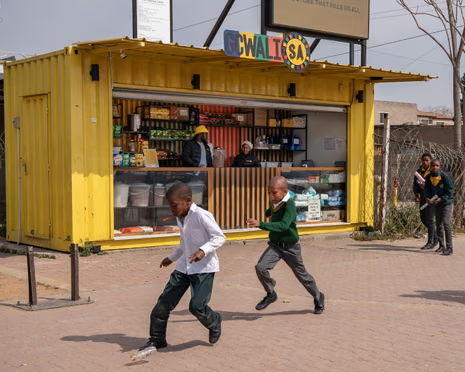
Gcwalisa, meaning ‘fill up’ in isiZulu, is a network of shops in South Africa designed to combat food poverty. The initiative operates six container-based shops throughout Alexandra township, a densely populated area within Johannesburg. These shops aim to provide essential goods to residents in a cost-effective manner, directly addressing the widespread issue of food insecurity in the region. By offering a unique retail model, Gcwalisa seeks to empower communities and alleviate the financial strain on vulnerable households, ensuring better access to key staples and household necessities.
The Poverty Tax Explained
Many customers in South Africa rely on government grants amounting to 350 rand (£16) per month, which often serves as a primary source of income for households. For individuals like Tsholofelo Mphela, who supports a family of eight as its sole breadwinner, these financial constraints are acutely felt. Mphela articulated the daily struggle, stating, "At times, I don’t have enough money to buy a 2kg bag of sugar." The cost of essential goods, such as a 2kg bag of sugar, is approximately 60 rand (£2.80), representing a significant portion of a monthly grant. This illustrates the acute challenge of making ends meet when basic necessities consume such a large percentage of available income. The limited funds available to many households necessitate careful budgeting and often lead to difficult choices between essential items.
The economic landscape exacerbates these challenges for many South Africans. Approximately 43% of the nation's working-age population is currently unemployed, contributing to widespread financial insecurity. This high rate of joblessness means that a substantial segment of the population depends on alternative forms of income, including social grants, to meet their basic needs. The limited purchasing power of these grants, particularly in relation to the price of staple foods, shows the financial pressures faced by vulnerable households. The reliance on these grants notes a broader societal challenge where a significant portion of the population struggles to access stable employment and sustainable income. This economic reality makes innovative solutions like Gcwalisa even more critical for daily survival.
Gcwalisa's Innovative Solution
Gcwalisa, an initiative designed to address food poverty, launched its operations in 2022. The organization aims to provide essential goods to residents in a cost-effective manner. Since its inception, Gcwalisa has rapidly expanded its footprint, and it now runs six container-based shops across Alexandra township, strategically located to serve the community effectively. These shops are not just points of sale but vital hubs for accessible and affordable provisions. In a move to enhance sustainability and operational efficiency, Gcwalisa installed solar panels on some of its container shops in 2023. This measure helps to reduce reliance on the national grid and potentially lower operating costs, which can then be passed on to customers through more competitive pricing. The adoption of renewable energy also demonstrates a commitment to environmentally conscious practices while simultaneously pursuing economic benefits for the community.
The shops offer a unique "weigh-and-pay" model, allowing customers to purchase exact quantities of goods, even small amounts, to fit their immediate financial capabilities. Sibongile Msomi, a customer at one of the Gcwalisa shops, exemplified this purchasing pattern when she bought 16 rands (£0.73) worth of Pine Gel cleaner. Msomi explained the necessity of such flexible purchasing options, stating, "I just received my pension, but it’s small money." This approach directly addresses the financial constraints faced by many South Africans, enabling them to acquire necessities without being forced to buy larger, more expensive packages. The model allows households to manage their limited budgets more effectively, ensuring they can stretch their funds to cover various essential items throughout the month. This granular control over purchasing power is a cornerstone of Gcwalisa's mission, providing a key alternative to traditional retail environments that often do not cater to the daily financial realities of low-income consumers. It empowers individuals to buy only what they can afford and immediately need, rather than being compelled to spend more on bulk items that might exceed their budget or storage capacity.
Voices from the Community
Gcwalisa's weigh-and-pay model is designed to directly address and avoid the phenomenon often termed the 'poverty tax'. This approach allows consumers to purchase precise quantities of essential goods, preventing the need to buy larger, more expensive packages that may be unaffordable given their limited budgets. The ability to buy only what is immediately needed or affordable helps households manage their finances more effectively. This model is particularly relevant in South Africa, where nearly 30% of children under five have suffered from stunting, a condition linked to chronic malnutrition. The economic pressures that contribute to food insecurity and malnutrition are compounded by traditional retail practices that often require bulk purchases, which can be inaccessible to those with minimal disposable income. By offering flexibility in purchasing, Gcwalisa aims to ease some of these financial burdens and improve access to food for vulnerable communities. The direct impact of this model is seen in the daily lives of residents who can now afford small, critical purchases that were previously out of reach, ensuring a more consistent supply of basic goods for their families.
Broader Implications and Future
A 2024 national survey revealed that nearly two-thirds of all households in South Africa were affected by food insecurity. Despite this alarming statistic, the country possesses a rich agricultural sector and produces more than enough food to feed its entire population, according to Prof Julian May, who heads the Centre of Excellence in Food Security at Cape Town’s University of the Western Cape. This paradox notes that the challenge is not one of scarcity but of access and affordability. May stated, "The country is self-sufficient in food and has adopted policies that succeeded in eliminating stunting in children in other countries, such as child support grants and free primary healthcare." He added that these policies have "failed to budge food insecurity" in South Africa, indicating a gap between policy intent and real-world outcomes.
The affordability of nutritious food remains a significant challenge, with May observing, "What is affordable in low-income areas is often unhealthy: low-cost, high-calorie, low-nutrient foods." This trend has contributed to a shift in public health, as obesity and diabetes recently overtook HIV and tuberculosis as the number one cause of natural death in the country. The availability of inexpensive, energy-dense but nutrient-poor foods exacerbates health disparities, creating a cycle where economic hardship directly impacts long-term well-being. Gcwalisa’s efforts to make essential, often healthier, goods accessible in smaller, affordable quantities represent a key step towards mitigating these broader public health and food security crises. By providing a viable alternative to the 'poverty tax' and promoting access to a wider range of goods, the initiative contributes to a more equitable food system and supports the health and financial stability of South Africa's most vulnerable populations. The long-term success of such models could offer a blueprint for addressing systemic food insecurity and its associated health challenges across the nation.