The United States government will cease funding HIV and AIDS prevention and treatment programs in South Africa, following allegations of the South African government's failure to protect its Afrikaner minority. This significant policy shift will see the US government stop funding programmes in South Africa intended to tackle the spread of HIV and Aids, a decision with broad implications for public health in the region. A U.S. State Department official confirmed that a "phased drawdown" of Pepfar funding, which supports these initiatives, would commence. The official attributed this decision to "South Africa's failure to make demonstrable progress on policy requests by the administration" regarding the safety of the Afrikaner community. This move marks a significant shift in bilateral health cooperation between the two nations, noting the intersection of foreign policy, human rights concerns, and global health initiatives.
The decision is explicitly linked to the South African government's alleged failure to protect the white-minority Afrikaner community. This linkage shows the political dimensions influencing what has historically been a humanitarian aid program. The U.S. State Department's confirmation of the drawdown indicates a firm stance from Washington, suggesting that diplomatic efforts to resolve these policy differences have not yielded the desired results. The cessation of funding represents a punitive measure, aimed at compelling South Africa to address the concerns raised by the U.S. Administration regarding the treatment and safety of its Afrikaner population.
Pepfar's Impact and Scale
Until 2025, the United States supported South Africa's HIV efforts with an estimated $400 million (£300 million) annually through the President's Emergency Fund for Aids Relief (Pepfar). This substantial financial commitment made the U.S. A cornerstone of South Africa's fight against the HIV epidemic. More than eight million South Africans are living with HIV, giving the country the highest number of people living with the virus globally. This staggering statistic shows the critical importance of strong funding and full programs to manage and mitigate the spread of the disease within the nation. The scale of the epidemic in South Africa means that any reduction in funding for prevention and treatment programs could have severe public health consequences.
Pepfar funding had been providing approximately a fifth of South Africa's total spending on HIV programs. This proportion notes the significant role that U.S. Aid has played in supplementing domestic efforts and ensuring the availability of essential services, including antiretroviral treatment and prevention campaigns. The withdrawal of this critical financial support will necessitate a substantial re-evaluation of South Africa's public health budget and strategy for HIV/AIDS. The funding faced potential cuts before receiving a reprieve last October. This intervention was described as a "bridge plan," designed to maintain support temporarily and provide a window for diplomatic resolution or adaptation.
The substantial financial contribution from Pepfar has played a critical role in South Africa's public health initiatives, particularly given the scale of the HIV epidemic within its borders. The program has been instrumental in expanding access to testing, treatment, and care, undoubtedly saving countless lives and improving the quality of life for millions affected by the virus. The withdrawal of this funding marks a significant shift in the resources available for these programs, potentially creating a vacuum that South Africa will struggle to fill independently. The long-term effects of this drawdown on public health outcomes in South Africa remain a serious concern for global health organizations and local communities alike.
US Concerns and Policy Demands
The decision to reduce funding for HIV programs is explicitly linked to the South African government's alleged failure to protect the white-minority Afrikaner community. A U.S. State Department official stated that the reason for the funding drawdown is "South Africa's failure to make demonstrable progress on policy requests by the administration." These policy requests stem from concerns raised by the United States regarding the safety, property rights, and overall well-being of the Afrikaner population in South Africa. The U.S. Administration has consistently voiced these concerns, making them a central point of bilateral discussions.
Shortly after President Donald Trump took office, he issued an executive order alleging that South African policies dismantled equal opportunities and fueled violence "against racially disfavored landowners." This executive order marked an early indication of the U.S. Administration's focus on the issue and its willingness to link it to broader policy discussions. The executive order also noted South Africa's case against Israel at the International Court of Justice and its links to Iran, according to the White House. These additional points suggest a broader range of geopolitical and foreign policy considerations influencing the U.S. Stance. The White House, in a statement, referred to these concerns as "unjust and immoral practices." Trump has also previously alleged that there is a "white genocide" taking place in South Africa, a claim widely disputed. This assertion, which Trump has falsely alleged, has been a contentious point in international discourse, often criticized for lacking factual basis and for potentially inflaming racial tensions.
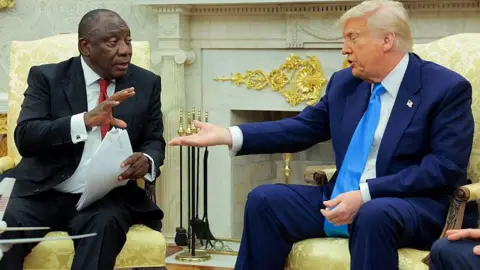
In response to these concerns, the U.S. Administration has established a refugee program specifically for Afrikaners. This program provides a pathway for members of the Afrikaner community to seek asylum or resettlement in the United States, further showing the U.S. Government's perception of a threat to this minority group. A meeting between President Trump and South African President Cyril Ramaphosa occurred just over a year ago at the White House, where these issues were reportedly discussed. This high-level engagement indicates that the concerns were communicated directly at the highest levels of government, suggesting that the current funding cuts are a culmination of ongoing, unresolved diplomatic tensions. More recently, the United States boycotted the G20 meeting hosted by South Africa last November, signaling continued diplomatic tensions and a deliberate effort by the U.S. To express its displeasure with South African policies on multiple fronts. This boycott was another clear indication that the U.S. Was prepared to use diplomatic and financial leverage to pressure South Africa.
South Africa's Response and Future
South Africa's health ministry stated that the provision of antiretroviral drugs was funded entirely separately from Pepfar. The ministry clarified that the majority of this funding originated from the South African government itself, indicating an existing capacity and commitment to managing its HIV/AIDS response. This statement from the health ministry aims to reassure the public that essential drug supplies will not be immediately jeopardized by the U.S. Funding cuts, albeit acknowledging the significant gap that will need to be filled.
The US government's intention behind the funding adjustments is to "foster self-reliance," according to a US official. This approach aims to reduce South Africa's dependency on American funding for its health initiatives, promoting the idea that middle-income countries should progressively take on full financial responsibility for their public health programs. A US official further stated that "South Africa is a middle-income country and is more than capable of supporting its own health programs." This perspective suggests that the U.S. Views its role as a temporary supporter rather than a perpetual provider of aid, encouraging South Africa to leverage its own economic capabilities to sustain its healthcare infrastructure. The claim that the US government's intention is to 'foster self-reliance' and reduce dependency on American funding positions the decision within a broader U.S. Foreign policy framework that encourages partner nations to become more economically independent.
However, the withdrawal of a fifth of the total spending on HIV programs, which amounted to an estimated $400 million annually, presents a considerable challenge for South Africa's national budget. While the health ministry asserts its ability to fund antiretrovirals, the full nature of Pepfar's support extended to prevention, testing, counseling, and capacity building, areas that may now face significant shortfalls. The South African government will need to swiftly identify alternative funding sources or implement drastic cost-saving measures to maintain the current level of services. This situation places immense pressure on South Africa's public health system, which is already managing the world's largest HIV epidemic. The long-term implications for public health outcomes in South Africa, particularly for vulnerable populations reliant on these programs, remain a critical concern as the phased drawdown of U.S. Funding commences.