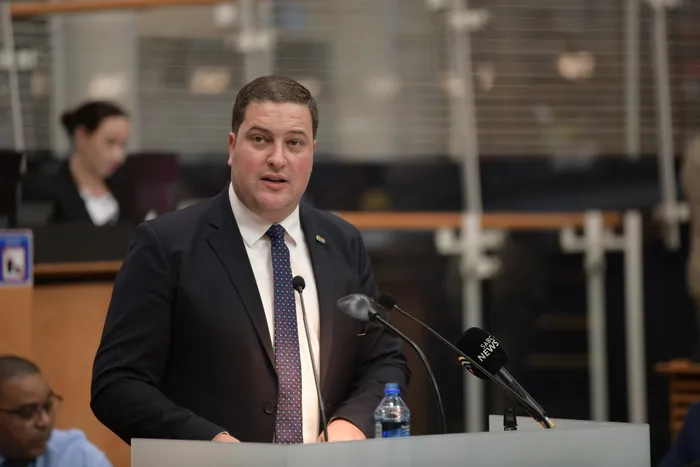
Cape Town Mayor Geordin Hill-Lewis announced plans to establish South Africa’s first Metro Police Detective Branch if he is re-elected in November. The proposal aims to address crime on the Cape Flats and is presented as a response to perceived deficiencies within the South African Police Service (SAPS). Hill-Lewis stated, "I want to say this plainly: the tragedy that happened here was not inevitable. It was not bad luck. We must never, ever accept that this is ‘just how things are’ on the Cape Flats." He attributed current issues to "a police service that does not have enough detectives to investigate the crimes committed against you."
The Mayor indicated his office has repeatedly requested investigative powers for Cape Town’s Metro Police to assist SAPS with violent crimes and secure convictions. "The fact is our national government is not serious about winning the war on crime. We are serious," Hill-Lewis said, adding that if re-elected, his administration would "recruit, train and deploy dedicated Metro Police investigators to work on gang violence, firearms and drug-related cases." He clarified this is "not a pilot" and would begin "the day after this election on 5 November." Anticipating opposition, Hill-Lewis acknowledged, "They will say policing is a national competency. They will say the city has no business building a detective capability." He countered, "we will no longer wait for SAPS to start doing its job... If we have to, we will go to court to force the issue."
Addressing Investigation Gaps
The proposed Metro Police Detective Branch would recruit, train, and deploy dedicated investigators to focus on gang violence, firearms, and drug-related crimes. This initiative is being put forward amid ongoing concerns about unsolved cases and the broader effectiveness of criminal investigations. Among these, four people, including a 13-year-old boy, were murdered in Zandkloof Street, Delft, three months ago. No arrests have been made in connection with these Delft murders, noting the investigative gaps the Mayor's proposal seeks to address. The inability to secure arrests in such high-profile cases shows the pressing need for enhanced investigative capacity within the city.
Currently, the City's Safety and Security Investigations Unit (SSIU) undertakes investigations into various matters. These include crimes related to firearms, drugs, and metal theft. The SSIU also probes attacks on City frontline workers, vandalism, and theft of public infrastructure, which are critical issues impacting public safety and municipal resources. It investigates gang activity within City affordable rental units, a persistent challenge in many communities, and conducts internal investigations within the Safety and Security directorate to maintain accountability and integrity. The existing work of the SSIU demonstrates the City's current investigative capabilities and its readiness to expand these functions. The Mayor's plan envisions building upon this foundation, leveraging existing expertise and infrastructure to create a more full investigative arm.
Legal and Political Hurdles
Cape Town Mayor Geordin Hill-Lewis has consistently advocated for the devolution of policing powers to capable Metro Police services, contending that municipalities should be empowered to assist the South African Police Service (SAPS) with investigations. This call for expanded powers stems from a belief that local authorities are better positioned to respond to specific local crime trends and needs. However, criminal investigations and detective functions are not explicitly listed among the functions of municipal police services as defined by the SAPS Act. This legal distinction forms the primary hurdle for the Mayor's proposal. The investigation of criminal offences remains a core responsibility of the SAPS under the current legal framework, which assigns this critical function exclusively to the national police service.
Section 64E of the South African Police Service (SAPS) Act 68 of 1995 specifically outlines the functions of municipal police services. These functions typically include traffic policing, enforcing municipal by-laws, and preventing crime, but do not extend to full-scale criminal investigations. Despite these current legal provisions, the City of Cape Town asserts that only minimal changes are necessary to the existing legal framework to permit municipal police to undertake additional investigative responsibilities. The City stated, "Minimal change is required to the current legal framework – with the necessary will powers for municipal police can be expanded within months." This perspective suggests the City believes the expansion of Metro Police investigative capabilities could be rapidly implemented if political will allows for legislative adjustments. This legal interpretation notes a potential area for legislative reform, where a shift in government policy could unlock new avenues for local crime fighting.
Mayor's Call for Action
Addressing concerns about the South African Police Service's capacity, there are close to 200 vacant detective posts across Cape Town police stations, according to available data. This significant shortage of personnel directly impacts the ability of SAPS to effectively investigate crimes and secure convictions, contributing to the backlog of unsolved cases. The City of Cape Town has already expanded its Metro Police force by more than 1,300 officers during Mayor Geordin Hill-Lewis's term, aiming to bolster local law enforcement capabilities and provide a more visible policing presence. These Metro Police officers play a key role in proactive crime prevention and intervention, demonstrated by their confiscation of more than 400 illegal firearms annually, noting their involvement in tackling serious crime at a local level. Despite these efforts and the volume of serious cases handled by Metro Police, only 5% of firearm cases handed over to the SAPS ultimately result in a conviction. This low conviction rate for firearm-related offenses is a critical statistic that shows the current challenges in the criminal justice system and provides a strong impetus for the Mayor's proposal to enhance investigative capabilities at the municipal level.
The City of Cape Town stated that the primary objective of expanding policing powers to include criminal investigations would be to "build prosecution-ready dockets to gain more convictions, especially for gang, gun and drug crime." This initiative does not aim to supersede existing structures or create a parallel police force. "Importantly, the City doesn’t seek to replace or compete with SAPS," the City of Cape Town explained, "but rather for our officers to have expanded powers to work with SAPS and the NPA to build prosecution-ready case dockets and deliver more convictions for specific crimes, especially gang, gun and drug crime." This collaborative approach is intended to complement the work of national agencies, rather than undermine it, by focusing on areas where local intervention can have the most significant impact.
The City maintains that the necessary changes to enable municipal police to undertake additional investigative responsibilities are minimal. "Minimal change is required to the current legal framework – with the necessary will powers for municipal police can be expanded within months," the City of Cape Town affirmed. This suggests a belief that legislative adjustments could be rapidly implemented if there is political support for the expansion of Metro Police investigative capabilities. The Mayor's office is prepared to pursue legal avenues if necessary, signaling a resolute commitment to addressing the perceived deficiencies in crime investigation and securing more convictions for the residents of Cape Town.